
Marketing ROI Demystified: Why You’re Struggling And What to Do
By Luke M. Jones
One of the most difficult tasks marketers face is quantifying the value of their work. Whether the work in question is a PPC campaign, the adoption of a new platform, or an inbound nurture sequence, calculating ROI tends to be a heavy lift—especially for marketers in smaller businesses where attribution models haven’t been implemented.
Many marketers fall back on anecdotal evidence that their work has an impact. Others argue that people outside of marketing simply don’t understand the value of branding or funnel building. Sometimes, calculations are presented by someone outside the marketing department that don’t fully reflect the nuances or impact of the work.
Let’s start with the basics. We all have an idea what ROI means conceptually, but what does it mean as a mathematical formula?
What Is ROI?
Let’s start with the basics. We all have an idea what ROI means conceptually, but what does it mean as a mathematical formula?
There are two commonly used equations:
Net Profit ROI:

Final Value ROI:

Since Final Value of Investment − Cost of Investment = Net Profit, these are essentially the same formula.
In practice, we need to figure out two things: the final result in monetary terms and the total cost. This is where many marketers get stuck.
Starting the ROI Calculation
If the goal is to acquire new clients, you’ll first need to assign a monetary value to each client. This usually comes from outside marketing and can be measured one of two ways:
- The average first payment made by a client or customer
- The Customer Lifetime Value (CLV or LTV), which represents the average total revenue a client generates over their entire relationship with your business.
As an aside, Immediate ROI (based on first payment) will typically paint a less flattering picture than Lifetime ROI (based on CLV). If Immediate ROI is the metric you’re given, ask why. Businesses should only lean on it during cash crunches when short-term revenue is critical—which generally isn’t a good omen for the business as a whole.
The goal could also be leads generated, site visits, impressions, or other KPIs. In these cases, the CFO typically assigns a value based on conversion rates—e.g, one client per every 50 leads.
Here’s an example to bring this to life. Say you run a LinkedIn ads campaign that nets 20 leads in the last month. You know that the conversion rate on LinkedIn Leads is 10%, which means 2 should become clients, and that CLV is $500. That brings the final value of the investment to $1000, If the cost of your LinkedIn campaign was $400, then the math looks like this:
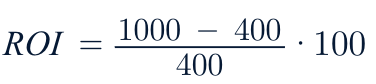
Thus the ROI is 150% percent, meaning that for every dollar spent, you get $1.50 in profit (don’t confuse this with ROAS, which gives you revenue rather than profit).
SUBSCRIBE TO OUR FREE MONTHLY NEWSLETTER
Cohorts: Where It Starts to Get Muddy
This might not seem too bad so far, but then come cohorts. Cohort tracking means taking all the leads generated in a given month and following them over time to see where they end up.
Let’s put this into practice. Say your average sales cycle is two months. When calculating ROI on client acquisition, you’ll need to track cohorts two months back. In other words, you should measure how many of the leads generated two months ago have since converted into clients.
But what if the sales cycle changes? Maybe it’s one month in the spring, three in the summer, or your reps are converting older leads from six to twelve months ago. This variability complicates forecasting and makes ROI calculations less straightforward.
Advertising ROI depends heavily on attribution—knowing where leads come from and what ultimately drives the conversion action.
The Attribution Conundrum
Advertising ROI depends heavily on attribution—knowing where leads come from and what ultimately drives the conversion action. Most businesses struggle to create a reliable, agreed-upon model. In smaller organizations, UTM codes often aren’t implemented or reported meaningfully.
Another complication: Most leads have multiple touchpoints. A prospect might see a display ad, search your brand, click a Google ad, sign up for your newsletter, download an ebook, and finally schedule a discovery call. In that scenario, what gets credit?
Marketers know each touchpoint deserves partial credit. However, unless you have a sophisticated attribution model, it’s hard to assign that fractional value. CEOs, meanwhile, typically want one clear source to credit.
So What’s the Solution?
First, accept that your ROI calculations won’t be perfect—and that’s fine. Don’t let the perfect be the enemy of the good. The goal is simply to determine whether something is worth continuing, tweaking, or discarding.
Start with the ROI formula as a framework before diving into the math. How much effort is required? How expensive is it? Do you have evidence of a positive outcome? Does the outcome justify the cost and effort?
First-touch attribution is often where the math starts to fall into place. Make sure UTMs are set up correctly across all channels. Ensure your website is capturing them, track GCLID for Google Ads, and confirm both the Meta Pixel and API are connected.
Once this data flows into your CRM, you’ll have a reliable single touchpoint to credit and can trace leads back to their source. After calculating how many clients came from each source, you can plug actual dollar amounts into the ROI formula for real, measurable values.
While first touch is a good starting point, a multi-touch model will ultimately provide a fuller, more accurate view of the marketing funnel. If your business has the technical resources and data framework to support it, make this a long-term goal. But remember—this is another case of not letting the perfect be the enemy of the good, since you’ll never capture every touchpoint.
Upper Funnel and Reengagement
There’s a tendency in the C-Suite to assume one marketing ROI model works for everything. It doesn’t. Upper-funnel and reengagement efforts require different approaches.
For upper-funnel campaigns, frame the investment in terms of the business problem you’re solving—and make sure it’s a company priority, not just a marketing goal. For example, if brand awareness is low, tying display ads directly to revenue doesn’t make sense. In that case, CPM becomes your ROI proxy: how many people were reached (and how many times) at what cost?
If the business is short on cash, lead generation will naturally take priority, and impression share may not matter. Accept this reality rather than resist it, and focus on generating leads with a real chance of converting.
Reengagement efforts also won’t fit neatly into a first-touch model and should be calculated separately. That’s okay. The key question is: how much did it cost to reengage dormant leads, and how many became clients afterward?
Finally, track the ratio of newer versus older leads your inbound team closes. This will reveal how vital long-term plays and reengagement efforts really are.
Next Steps
That was a lot—so here are a few practical next steps:
- Get Customer Lifetime Value from your finance team. Understand your average sales cycle and any seasonal variations.
- Learn and use the ROI formula—both conceptually and with real numbers.
- Set up a first-touch attribution model using UTMs. If needed, hire someone who can do it properly.
- Create a clear business objective for every campaign, and align your metrics accordingly.
- Set a long-term goal for implementing multi-touch attribution.
You can do this!
Share this on:
About Luke M. Jones

Luke M. Jones, Editor-in-Chief of CreativeScience.io, has over a decade of experience in digital marketing, leveraging his expertise in inbound marketing, SEO, PPC, and marketing automation to drive growth and lead strategic campaigns. He holds a B.A. in Journalism with a concentration in Graphic Design from the University of North Carolina at Chapel Hill and an M.F.A. in Creative Writing from Emerson College. Jones is recognized for his resourceful problem-solving, team leadership, and ability to execute high-impact marketing initiatives.